
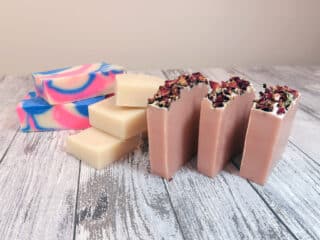
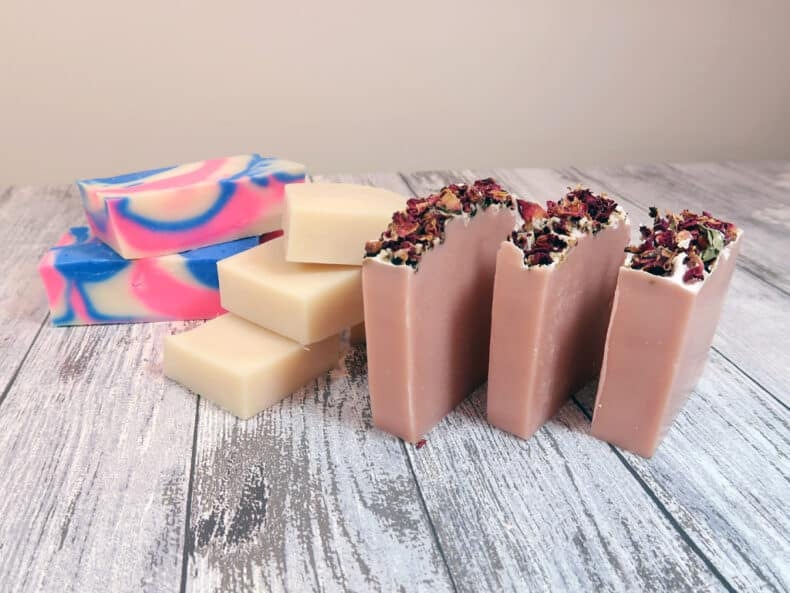
Who said lard soap has to be boring? In this post, I am sharing three great lard soap recipes that prove just how wonderful this traditional ingredient can be.
Lard and tallow are perfect for beginners because they are inexpensive, easy to work with, and very forgiving. If a batch does not turn out quite as planned, it is much less disappointing than losing expensive oils and butters.
But do not let the low cost fool you. Lard soap makes a beautiful, pure white bar that produces a creamy lather and plenty of bubbles. And when you add a little creativity, your homemade lard soap can look and feel every bit as luxurious as those made with pricier ingredients.
Lard Soap Is Surprisingly Versatile
This first DIY lard soap we are making is a simple lard soap that has excellent cleansing benefits and is great for anyone with sensitive skin. Then I’ll show you my rose petal lard soap with pink clay, and my funky bubble gum lard soap that’s perfect for the bath.
So, in sum, lard and tallow is very economical and creates hard, long-lasting bars. It’s a great ingredient to experiment with different soap making techniques without breaking the bank!
I’m starting with a simple no thrills soap recipe then I’m going to show you how to spruce it up and give it a completely different look and feel. I’ll show you that soap making can be very diverse without needing to use lots of expensive ingredients.

Choosing The Right Mold

In the past, I’ve used plastic Tupperware, wood, and glass molds with great success, but they do need to be lined with waxed baking paper or the soap is nearly impossible to remove.
The easiest mold to use is a flexible silicon mold as it’s so easy to remove the soap from once it’s hardened.
On the downside, they do need to be supported. Silicon molds are very flexible and ‘floppy’ for lack of a better word. So unless you are using a purpose-built soap mold, It will need to be stood on something solid like a book or cutting board.
My No Thrills Lard Soap
This first lard soap is a simple lard soap that has excellent cleansing benefits and is great for anyone with sensitive skin.

Quick Tips
- If Lard soap is left unperfumed, it can have a bit of a fatty smell, so I always add a little essential oil to this soap.
- Sweet orange is a good choice for a morning wake-up call and de-stressor. However, If you do have sensitive skin, stick to one of the more gentle essential oils like Lavender.
- Lard is quick to trace so make sure you have your mold and fragrance ready to grab when you need it. This goes for all 3 recipes in this blog post.
Watch How To Make Basic Cold Process Soap
If you haven’t made soap before, take a few minutes to watch the video and basic steps for making CP soap at home.
If you enjoy making cold process soap and want more reliable results, you might also like my Natural Soap Making Course.
Inside the course I share tested recipes along with clear guidance on oils, lye, colors, and additives, so you can make beautiful, dependable, & natural soaps with confidence.
It’s 25% off this week. 👉 Explore the course here


As an Amazon Associate, I earn from qualifying purchases. If you buy via the links here I may earn a small affiliate commission at no cost to you, please read my affiliate disclosure.
Ingredients
Equipment
Method
- If you’ve not made soap before, take a look at my full cold process tutorial here.Make sure you are making the soap in a well-ventilated area. Put on your gloves and eye protection, your mask, apron, and long rubber gloves. I always find it best to then prepare and weigh all of the ingredients before starting.

- 266 grams Distilled Water, 133 grams Soapmaking LyeWeigh the water into a glass jug. In a separate container, weigh your sodium hydroxide/lye crystals. When you’re ready, slowly combine these by pouring your lye crystals into the water (not water into lye) and stirring. This will result in a chemical reaction, and the lye water will begin to increase in temperature and release noxious fumes. Turn your head and lean away while stirring, so as not to breathe any of the fumes in. now place it to one side, somewhere well ventilated, and allow to cool as we get on with our other steps.
- 1000 grams LardWeigh and melt the lard. You can do this in a saucepan over a gentle heat, or in a large glass jug and use a series of 30-second bursts in the microwave. If you are using a saucepan, it is so important not to allow the lard to burn. Very gentle heat is all that is necessary.
- Whilst your oils and lye are cooling weigh out your essential /fragrance oil and prepare your mold if needed. As mentioned earlier, lard soap batter reaches trace quickly so it's good to be prepared.
- When the lye and oils have cooled to around 120° F (54C) to 90f (32c), pour the lye/water mixture into the oils in a thin stream.
- Use an electric stick blender to blend your mixture in bursts of a few seconds.
- Continue blending until the batter is thick enough to leave a trace line on the surface of the mixture when you trickle some of the soap off the blender or a spoon. (commonly referred to as the ‘trace stage’)
- 30 grams Essential Oil or Fragrance OilAdd any optional coloring and essential/fragrance oils and stir well. In this soap, I am not using any soap pigment as I want to keep things simple, but you can add a variety of soap safe pigments to create whatever color your heart desires.
- Pour your soap into the mold. Cover the top with a lid or card, then wrap it in a towel and allow it to set for 24 hours in a nice warm area.
- After 24 hours the soap should be hard enough to remove it from the mold. The soap should still be soft enough to cut into bars with a dedicated kitchen knife or soap cutter.
- Once you’ve cut your bars, You will then need to leave your soap in a dry place to cure for around a month, turning once in a while before it’s ready for use.


New to DIY skincare?
If you’re enjoying making your own products, you might like Radiance, my free email course where I teach the foundations of DIY skincare step by step!Beautiful Rose Soap With Lard

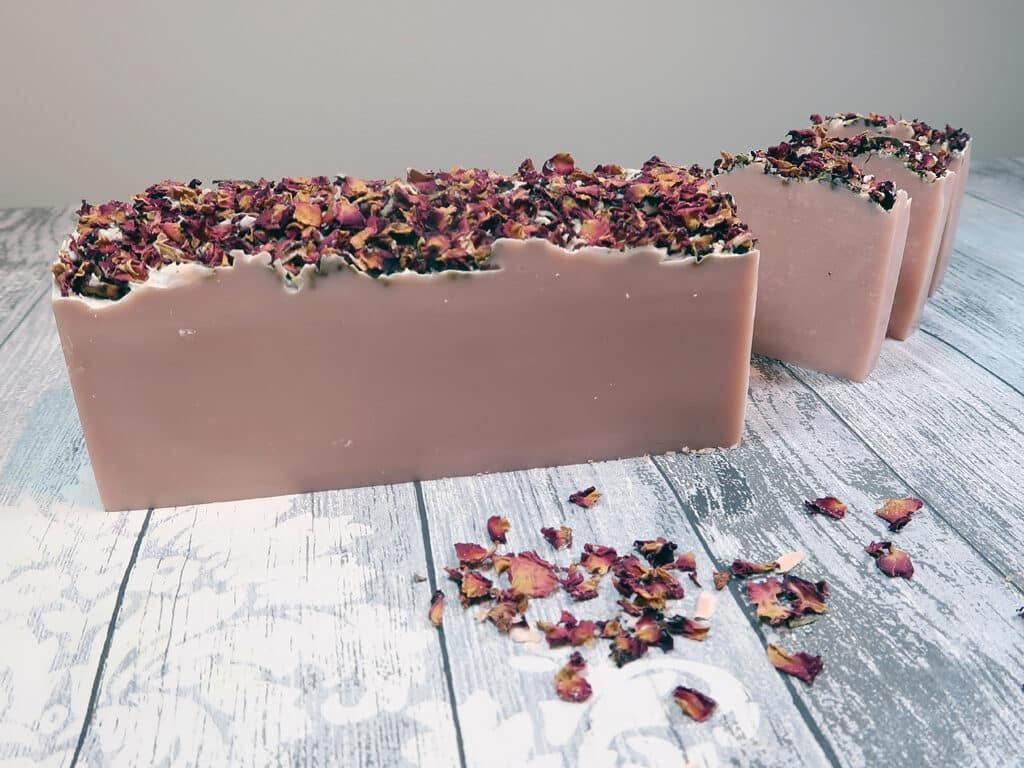
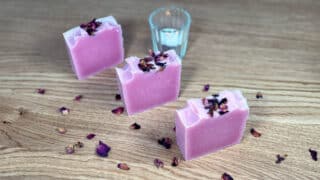
The same ingredients as the simple lard soap above, but we are adding some wonderful Australian pink clay that is great for drawing out all those toxins that are blocking up our pores.
Rose petals give the soap a touch of luxury. If you don’t want to use petals or you can’t get hold of any, you can make this soap without them, and the finished soap will still look great.
I’m using essential oils in this recipe as it keeps it natural. Rose essential oil is far too expensive to add to soap, so I’ve chosen rose geranium, teamed up with lavender and lemon which gives this soap a classic floral scent with great cleansing properties.
You can substitute the essential oils for a rose fragrance oil, or any other floral fragrance you choose, just make sure they are suitable for use with cold processed soap.
Ingredients
- 1000g Lard
- 133g Lye
- 266g Distilled water
- ½ teaspoon rose-pink clay
- 2 tablespoons of distilled water
- 15g geranium essential oil
- 11g lavender essential oil
- 7g lemon essential oil
- A handful of dried rose petals
- Rubbing Alcohol
Method
Step 1: In a separate container, mix the clay with a couple of teaspoons of distilled water and set it aside for later.

Step 2: Follow the steps above (for the no thrills lard soap) until you reach trace (step 7). Once you have reached trace, stir in the clay followed by the essential oil.

Step 3: Bring the soap up to a nice thick constancy; thick enough so that you could spoon it into the mold.
Once you’ve poured or spooned the soap into the mold, give it a good couple of taps on the counter to make sure there are no trapped air bubbles.

Step 4: Using the back of a spoon, create a textured effect on the top of the soap.
Then, sprinkle the rose petal’s onto the soap, pressing them down enough so that they will stick. Be generous as some will inevitably fall off later.

Step 5: Spray the top of the soap with a little rubbing alcohol, this will stop any ash forming.
Wrap a towel around the soap mold to keep it warm. If you have chosen not to add the rose petals, there’s no need to spray with the alcohol, just cover with a lid and wrap with a towel.

Step 6: Leave to set for 24 hours before removing the soap from the mold. Turn the soap on its side and cut it into bars. Cutting the soap sideways will help stop the petals from being dragged through the soap.

Step 7: Leave the soap to cure for 4 weeks, turning occasionally.
Funky Bubblegum Swirled Soap

This is a fun soap that’s perfect for the bath. Lard soap is usually pure white, so when you add color, it really makes it pop.
Although this can be made in a loaf-shaped mold, I prefer the finished effect when I’ve used a shallow square-shaped mold.
I’m using a powdered neon soap pigment that I’m pre-mixing with a little oil and a fun bubble gum fragrance oil to fit my theme.
Notes On Pigments
Not all colorings are oil soluble so always check before using them. The other thing to check for is that they are suitable for cold process soap and that they don’t bleed.
I’m recommending some pigments I purchased from PureNature, which can be found here.
You can also substitute them for mica on Amazon, but they won’t be quite as bright.
Ingredients
- 1000g Lard
- 133g Lye
- 266g Distilled water
- 30g fragrance oil
- ½ to 1 tsp Neon pigment Pink and blue soap coloring
- 4 teaspoons olive oil
Method
Step 1: Let’s prepare the colors; Check whether your soap coloring is oil or water-soluble. Mine is oil soluble so I’m going to mix each of my colors with 2 teaspoons of olive oil.
If you are using water-soluble colors mix them with 2 teaspoons of water. Make sure you fully dissolve them. I like to use a milk frother for this job as it speeds up the process. Then, set aside for later.

Step 2: Follow the same steps as you would if you were making the no thrills lard soap recipe up to step 7. You only want to bring this up to a very light trace.

Step 3: Divide the soap batter into three separate jugs. This doesn’t have to be completely accurate, just use your best judgement.

Step 4: Add the pink color to one and give it a blend or whisk to make sure it is well disbursed. Do the same with the blue coloring.
Then, divide the fragrance oil amongst the jugs, but don’t try to blend the soap batters from here on as the fragrance oil may cause the soap to become too thick to pour, so just use a hand whisk or spoon to gently disperse it.

Step 5: The key to getting a good marbling effect is pouring the soap from a height. Start pouring one of the colors into the corners of the mold, you will probably use around half of the jug.
Step 6: Next, choose another color and pour that into and through the color that you have just poured. Then do the same with the final one. Repeat this procedure until all the colors have been used.

Step 7: Place a piece of cardboard over the top of the mold and wrap it with a towel to keep it warm. Leave the soap to set for 24 hours before removing it from the mold.

Step 8: Cut the soap into chunky bars and leave to cure for 4 weeks, turning once in a while.

Once the curing process has passed, test with a PH strip to ensure your soap is safe to use on skin.

Final Thoughts
So that’s it! Three ways to make lard soap. The first method I often recommend to beginners, because it’s such a cheap and easy ingredient to work with.
But sometimes it’s difficult to know when you’re ready to take the next step. This is why I’ve combined a few more advanced soap making techniques with my lard soap recipe. It’s a great way to effectively, and inexpensively, practice new techniques.
So if you see someone doing something interesting on a soap making blog, such as swirling soap pigments or embedding things on top of soaps, it’s a great Idea to try these techniques on a tallow or lard soap first.
There’s nothing more devastating in soap making than when soap goes wrong and you’ve wasted your lovely ingredients on a soupy soapy mess that’s no good to anyone. So why put yourself through that?
I also use this method if there’s a new ingredient I’ve never used before. A great example is fragrance oils. While a supplier might tell me a certain fragrance oil is great in cold process soap, I don’t always trust them. I’ve been burned by poor ‘manufacturer guidelines’ in the past.
I’ll usually always try out a new fragrance or essential oil in a lard soap first, just to be doubly sure before using it in more expensive formulations. Your bank account will certainly thank you in the long run!
If you’re looking for more interesting ways to make soap, take a look at how to make soap at home or my liquid soap recipe. It’s a lot easier to make liquid soap than you may think!
Don’t forget to follow us on social media, as well as sign up for a newsletter for all the latest info on what I’m getting up to.



love it
If I want to do masterbatching with these recipes (I already have a lot of 50/50 lye/water made). Do I need to change the ratios of anything?
I can’t say enough good things about your basic lard recipe and the rose one.Unfortunately, I didn’t add enough essential oils, and I can still smell the fat in the soap.I made another batch with green kaolin clay and rosemary/mint/pine essential oils, and replaced the water with goat milk.Came out amazing, but some soda ash formed on the top and edges.I used the silicone mold which holds about 6 bars.I will have to spray it with isopropyl alcohol next time.
You’re doing all the right things Ann, thanks for letting me know how you’re getting on! So glad you’re enjoying the recipes! In reference to the lard soap, this is a common problem. Like you said you can up the essential oils, but lard soap does have a funny smell to it. Do keep me updated on all your soaping adventures. Thanks Ann <3
What kind of lard do you use for this basic recipe? I need something that won’t cause my son’s eczema to flare up. Also, what essential oils, other than lavendar, would you recommend for the fragrance, again, keeping in mind my son’s eczema. Thanks for your help!
Hi Shaw,
I’m very sorry about that. We dont have control over the content of our ads. Nevertheless, I hope you enjoy your lard soap! It really does produce such a glorious soap.
Hi there! Thank you so much for the recipes. What size is your soap mold to accommodate the entire batch?
Hi Heather,
The batch size is roughly 1.429kg (1,429g), so you’re going to need a mold that can contain up to 1.5kg of soap batter.
As a homesteader, I got into soap to use up the lard and tallow from our local farms and the animals we raise here. Thrilled to find a no frills lard recipe as well as some fun variations.
Second recipe I’ve tried from your site- started with your honey/beeswax. Love the simplicity and expect this to come out amazing. Thanks for this site and the resources!
That wonderful to hear MamaCass, I’m so glad you’ve found a way of using up your ingredients. Let me know how you get on with our other recipes! 😀
Hello! I was just wondering where you get your lye and Lard for your soap? I really wanted to try it but don’t have the ingredients!
Merritt
Hi Merritt,
I get my lye online. I have a post that talks about where to find soap ingredients, check it out. As for lard, I actually get it from my local grocery store. You might find it called animal shortening or dipping. It’s usually kept with the home baking stuff if that aisle has a refrigerator, otherwise check the dairy section.
What scales do you reccomend for weighing out Lye and Lard?
Hi Leslie,
Any digital scale that will measure in grams should be totally fine. I find, with soapmaking, you kind of have to use grams. It’s much more accurate than our standard ounces. Take a look at what I’ve said here, it might help you make a choice.
Hi Shanaha,
The average quantity of essential oil you would use here would be about 2tsp. Although I would use something quite strong smelling.
Hope this helps!
can i use coconut oil instead of shortening or lard and tallow..?
Hi Lori,
Absolutely you can! To be on the safe side, I would run it through a soap calculator first to make sure everything works out okay.