
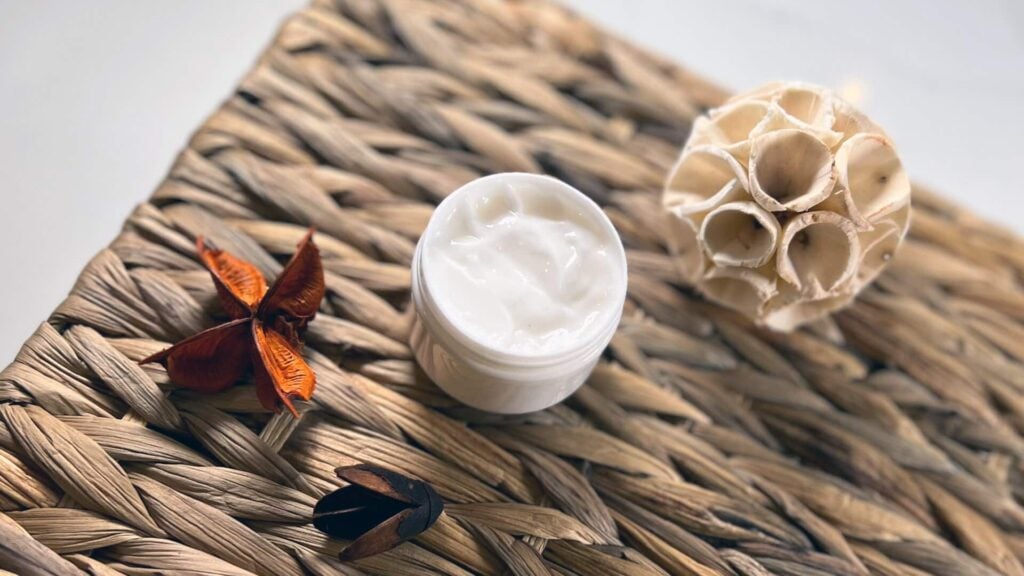
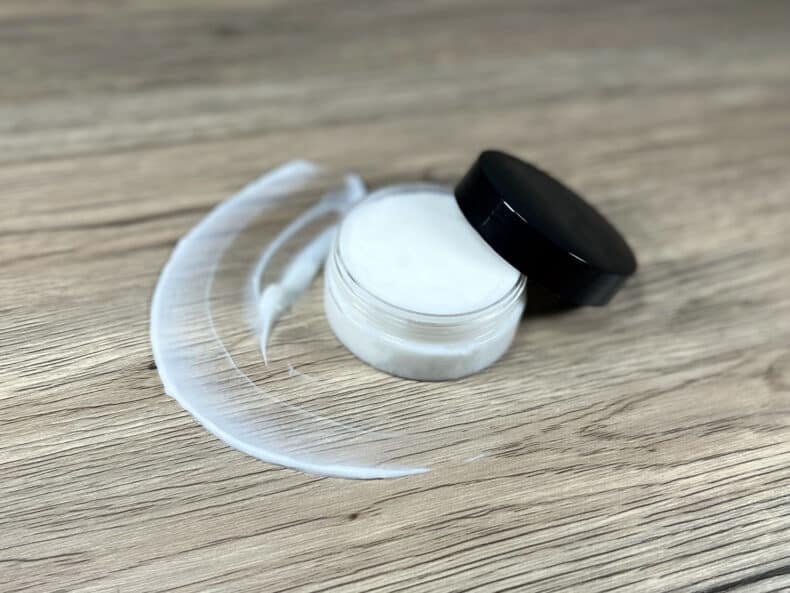
I’ve refreshed this homemade face cream a few times over the years, each update making it a touch smoother and more nourishing. This version is my favorite so far, it absorbs beautifully, feels silky on the skin, and gives a healthy, hydrated look without any heaviness. If you’re new to making skincare, it’s a lovely, confidence-building formula to start with.
This version is my rose anti aging cream for mature skin, a lovely beginner friendly recipe if you are new to making skincare. The recipe blends gentle hydrators with lightweight oils for lasting moisture and a smooth finish.
Rose hydrosol, squalane, argan oil, shea butter, and a hint of hyaluronic acid all play a clear role in the texture and feel of this homemade face moisturizer. Once you see how the phases come together, you can easily adjust it to suit your own skin.
About My Homemade Face Cream
Just like my popular DIY wrinkle cream, this updated DIY face cream helps reduce and prevent fine lines. It’s beautifully non-greasy, absorbs quickly, and leaves your skin silky soft. I like to apply it after my homemade anti-aging serum, it helps the serum absorb faster and balances any leftover oiliness.
If you’d like to explore more creams and moisturizers, I cover this in much more depth inside my Fabulous Face Creams & Moisturizers Course.
Inside the course I share a wide range of tested recipes for creams, gels, oils, and balms, along with clear guidance on how these products are built and how ingredients work together. This makes it much easier to adapt recipes or start creating your own when you’re ready.
It’s 25% off this week. 👉 Explore the course here
This DIY face moisturizer is designed for dry, mature, or dehydrated skin that needs a little more support than a basic moisturiser can give. It has a soft, silky texture that absorbs well without leaving the skin greasy, and it layers beautifully with serums or heavier night creams.
The formula uses a blend of rose hydrosol, shea butter, squalane, and hyaluronic acid to hydrate, soothe, and smooth the skin. I’ve kept the ingredients simple, gentle, and effective, the same approach I use for all my everyday moisturisers at home.
What’s In This Face Cream Recipe?
I’ve formulated this homemade face moisturizer for aging skin, however, it includes a blend of gorgeous natural ingredients that will nourish all skin types. Let’s take a look.
Carrier Oils and Butters
I didn’t want to overcomplicate this formula, so I’ve gone for just the one carrier oil and cosmetic butter. For these, I’ve selected Argan Oil and Shea Butter.
You may have seen it as an ingredient listed on many different hair treatments, but Argan oil is also fantastic for dry skin. It’s intensely hydrating, packed with nutrients, and high in antioxidants. So kiss goodbye to dry, dull, and damaged skin.
And I’ve paired this with shea butter, perhaps one of my favorite cosmetic ingredients. It’s even more nourishing and hydrating than the argan oil.
It also helps to soften the skin, leaving it feeling silky, soft, and supple. You’ll be surprised how much dry skin can bounce back with care and the right ingredients.

Humectants and Olive Squalane
Because no emulsion is complete without a humectant, I’ve decided to really treat myself. And so should you! Humectants are ingredients that draw moisture to a product. It helps keep them from going dry in between uses but also helps to keep the skin more supple.
That’s right, humectants will draw moisture from the atmosphere and impart it to the skin when applied. Therefore, this formulation will continue to hydrate your skin long after you have applied it.
Glycerine is perhaps the most universal humectant, and just about anyone should be able to get hold of it. But I’ve paired it with d-Panethol, which is fantastic at soothing skin, reducing inflammation, and delivering hydration to deeper levels of our skin.
Hyaluronic Acid
However, my favorite humectant of all is hyaluronic acid. It’s such a strong humectant that the plumping effect can actually help to ease fine lines and wrinkles. It’s also one of those trendy ingredients, so your friends will be impressed that you’re using it in your own formulations!
Making Hyaluronic Acid Gel
Sometimes I can’t find premixed hyaluronic acid gel, so I make my own using hyaluronic acid powder. It’s super simple and a great way to have it ready for your formulations. I’m including the basic steps below, however, more info on this can be found in my Luxury Serums Course.
- Weigh out 1g of hyaluronic acid powder, 1g of a water-based preservative such as Plantaserve P (Saliguard PCG), and 98g of distilled water.
- Sprinkle the HA powder over the water without stirring, add your preservative, and then cover the container.
- Let it sit undisturbed for several hours. How long depends on the molecular weight of your HA, but basically until the powder is fully hydrated and there’s no dry residue. Once it’s all absorbed, stir well to get a smooth, uniform gel.
- Bottle it up, label it, and you’re good to go! It stores well and is super handy for quick use in serums or lotions.

Aromaceuticals
Now, we come to our essential oils. Not only do they smell amazing, but they also provide therapeutic benefits. I’ve selected rose geranium and ylang-ylang essential oils. They both have beautiful floral aromas that will pair well but about those benefits for our skin?
Rose geranium is great for balancing the skin’s oil production. While this might sound like it’ll make the skin drier, which is true if you have oily skin, it does the opposite on dry skin. It’s magic stuff, really!
The ylang-ylang is also deeply hydrating, penetrating deep to provide moisture at the very core of our skin. Furthermore, it synergizes with our rose geranium to help boost the production of natural oil in the skin.
Squalane
Squalane naturally exists in our skin and has many important functions in our body, too. It’s one of the skin’s natural lubricators, keeping skin feeling soft and moisturized on its own.
However, as we age, production diminishes, and by 30, we probably won’t be producing any in our skin anymore. The body actively redistributes away, leaving the skin lacking.
But we can replenish these levels by using a supplement in the form of olive squalane. It’s basically the same thing but derived from olives. And boy, does it sink in fast! It really is a magic oil.
Making Your Own Floral Infusions
To give your DIY face moisturizer that little extra, you can substitute all of the distilled water in the recipe with floral waters (also known as distillates, hydrolats, and hydrosols).
The recipe already calls for some rose hydrosol. Still, you can, if you wish, substitute all the distilled water for this ingredient.
Alternatively, you can make your own floral infusion by steeping dried flower petals or herbs in boiling water for 10 minutes, then straining through a fine strainer or piece of muslin.
For a more in-depth look at how to make your own herbal and floral infusions, please take a look at my post, which shows you exactly how to brew one up in your own home!
Preservatives In DIY Face Moisturizers
The homemade face cream below can be kept for a couple of days without preservatives and for 12 months with preservatives added. We don’t, however, recommend omitting it. Who wants to have to make their own face cream every week?
This is particularly important if you go down the ‘making your own floral infusion’ route. You must use a preservative, or it will only stay fresh for a limited time. Even with the preservative in it, you will still have to reduce the cream’s lifespan to 4 months (12 months with purchased flower water/distilled water).
That’s not to say that I wouldn’t recommend making floral infusions; I definitely would; make sure you use a preservative to get your four months.
Adding The Preservative
When it states to add the preservative, you will notice I give a choice of when to add it. When buying your preservative, the packaging should always give a guideline of when it can be added, along with a maximum temperature limit.
Most can now be added at the cooldown phase; this is my preferred method as it eliminates the chance of overheating and destroying it. But always check the recommended usage guide before buying it. Unless otherwise stated, these homemade face creams keep for about one week without preservatives and 12 months with preservatives added.
Ok, let’s make my not-so-basic face cream recipe!
Quick Ingredient Substitution Guide
- Rose Hydrosol: You could choose a hydrosol of your choice or replace it with more distilled water.
- D Panthenol Powder: If you use the hydrated (liquid panthenol), this is not heat stable, so you will need to add it with your cool-down ingredients. If you choose to leave it out altogether, up the glycerin by 1g.
- Argon Oil: Sweet Almond Oil or Jojoba Oil would be good but you could use any that you have to hand.
- Shea Butter: Cocoa butter or Mango would work well.
- Olivem1000: Another emulsifying wax of your choice, but this may affect the thickness of the finished product.
- Cetyl Alcohol: Cetearyl alcohol would be my first choice if I had no cetyl alcohol.
- Hyaluronic Acid Gel: As this is the star of the cream, it isn’t easy to substitute. Replace it with more glycerin, or maybe try sodium lactate.
- Rose Geranium and Ylang Ylan Essential Oils: You can use any essential oil of your choice.
Watch The Video
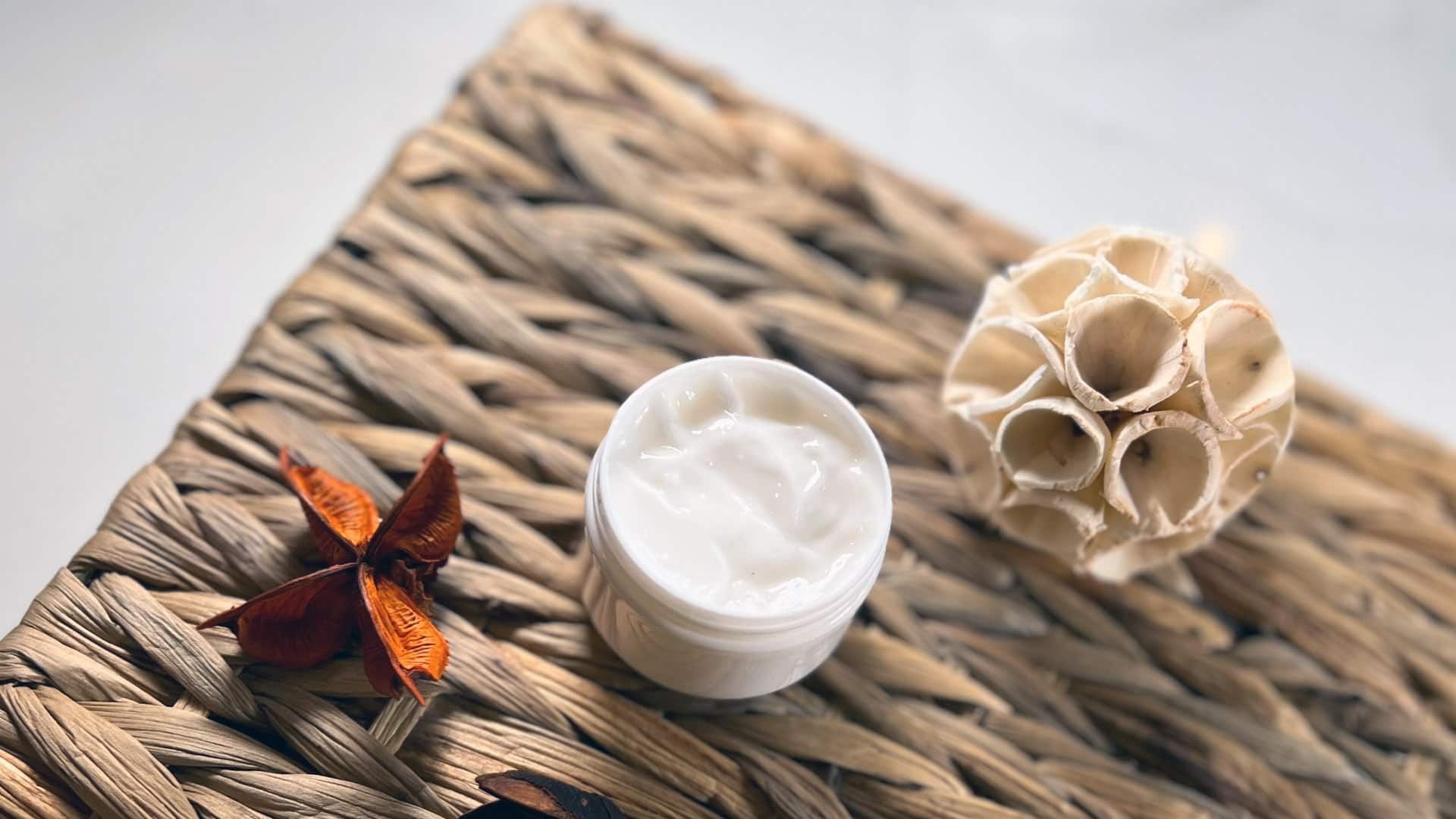

How To Make Face Cream For Glowing Skin
As an Amazon Associate, I earn from qualifying purchases. If you buy via the links here I may earn a small affiliate commission at no cost to you, please read my affiliate disclosure.
Ingredients
Equipment
Method
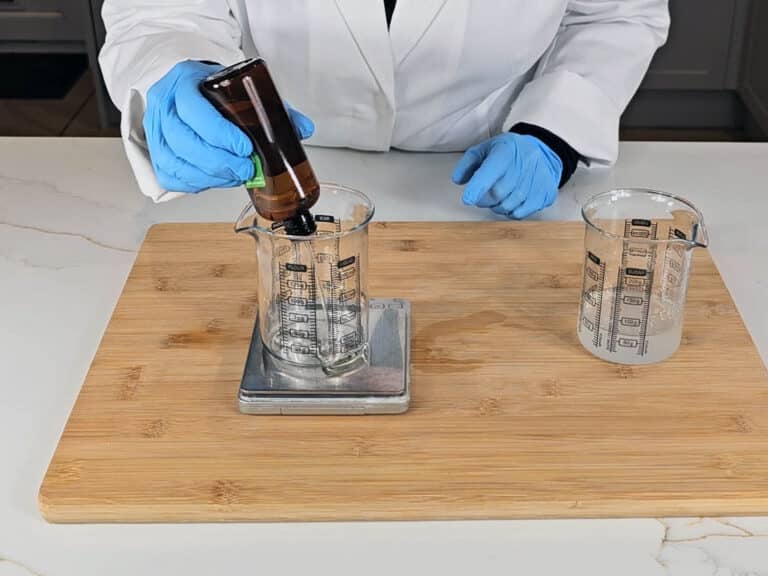
- 0.2 g Xanthan Gum, 4 g GlycerineMix the xanthan gum and glycerin in a small heatproof container until smooth.

- 34 g Distilled Water, 30 g Rose Hydrosol, 1 g D-Panthenol PowderAdd the distilled water, rose hydrosol, and panthenol. Stir well to form the water phase.
- 8 g Argan Oil, 5 g Olive Squalane, 2 g Cetyl Alcohol, 3 g Shea Butter, 5 g Olivem 1000In a second container, combine the argan oil, squalane, cetyl alcohol, shea butter, and Olivem 1000.
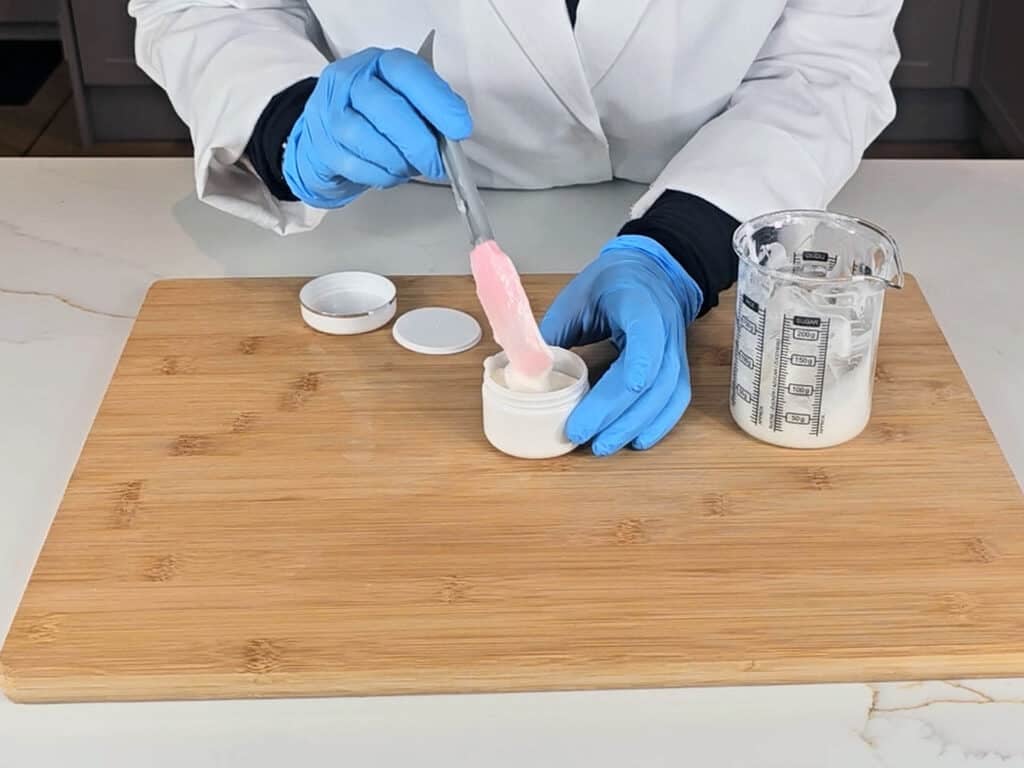
- Place both containers in a bain-marie (water bath) and heat gently until the waxes and butters have fully melted.
- Pour the water phase into the oil phase. Blend for 1–2 minutes, then switch to a spatula and stir until the cream thickens and cools to 40°C (104°F).
- 1 g Vitamin E Oil, 5 g Hyaluronic Acid GelAdd our cool-down ingredients. Start with the vitamin E, followed by the hyaluronic acid gel, stirring these in well.
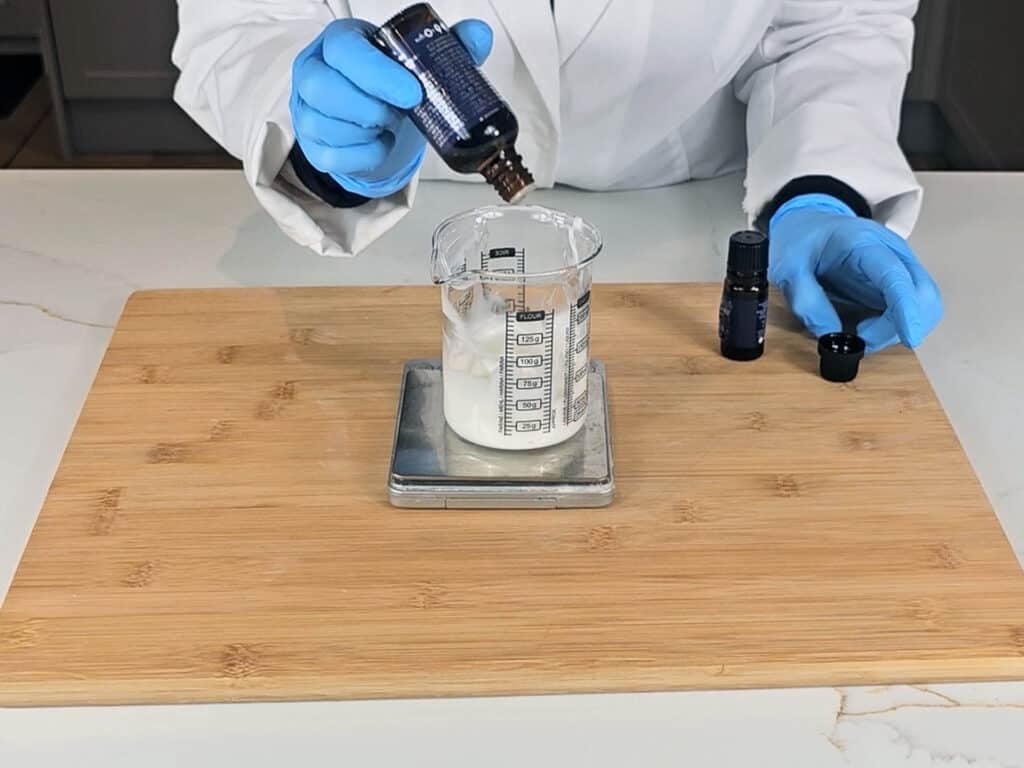
- 0.4 g Rose Geranium Essential Oil, 0.4 g Ylang-Ylang Essential Oil, 1 g PreservativeAdd the essential oils, followed by the preservative and stir again to make sure everything is fully combined.
- 1 Cosmetic Jar 4 ozTransfer to a suitable container ready for use.




Notes
New to DIY skincare?
If you’re enjoying making your own products, you might like Radiance, my free email course where I teach the foundations of DIY skincare step by step!More Face Cream & Moisturiser Recipes
If you enjoy making your own skincare, you might also like some of the other DIY face moisturizer recipes we’ve shared on the blog. Each one uses slightly different oils, butters, or textures so you can experiment and find what works best for your skin.
- Natural Moisturiser – a course lesson on easy beginner-friendly creams
- Anti-Aging Face Cream – a richer moisturiser designed to support mature skin
- Aloe Vera Face Cream – a lightweight, soothing moisturiser that absorbs beautifully
- Rose Face Cream – a beautifully scented cream that feels luxurious and nourishing
Browse all skincare tutorials →
DIY Skincare Recipes
FAQ & Troubleshooting
How do I use this DIY face cream?
Apply a small amount to clean skin and massage in circular motions. Use a little extra on areas that feel dry, such as the cheeks or jawline. If you have particular areas of skin that suffer from dryness, you can apply more liberally here. The cheekbones can often be a little drier than the rest of the face, so applying more here can be very beneficial.
How long does this homemade face moisturizer last?
With a broad spectrum preservative at one percent, your cream should last up to 12 months when stored in a clean, cool place.
How often should I use it?
Studies have shown that after 8 hours, only 50% of your face cream remains on the skin surface. So, you should absolutely use your DIY face cream daily. Morning and evening work best. If your skin is very dry, pair it with a heavier moisturiser at night or layer it over a serum. If you have very dry skin, you can combine this with a heavier face moisturizer or a serum. You may also want to use this lighter cream in the morning and your heavy moisturizer in the evening for intense hydration overnight.
Why is my face cream recipe splitting?
This is likely a problem with your water-to-oil proportions or your e-wax is not up to scratch. Take another look at your e-wax and make sure it’s a good quality one. Polar wax, NF, BTMS-50 are all good choices and work fantastic.
If your e-wax is fine, then your emulsion is destabilizing because your oil and water parts have been measured incorrectly. Make sure to take care when measuring your ingredients, and always use a good digital scale to get accurate measurements. Furthermore, this formula and suggested e-wax is for oil-in-water emulsions only.
Why is my cream too runny?
If your face cream is too runny, there’s likely a problem with the emulsifying wax. Check to make sure it’s in date, and that you’re using a good quality e-wax, such as Emulsifying Wax NF, Polawax or BTMS-50.
If you do find that your cream is too runny, and wish to salvage it, you can gently melt it down and add a few more grams of e-wax. This should thicken up nicely. This is best done before you add your cooldown ingredients.
What preservative should I use?
Selecting the right preservative seems difficult but is actually pretty simple. You’re looking for something that is broad spectrum but can be soluble in either oil or water for an emulsion formula. I use either Geogard ECT, Preservative Eco, Germaben, or Saligaurd (Plantaserve P). Any of these will work just fine in your emulsions and should prevent any microbial growth for about 12 months.
You will notice that this formula also calls for an antioxidant, in the form of vitamin e. You can swap this out for Rosemary co2 extract if you prefer. However, it is not a preservative on its own. Antioxidants prevent oils and fats from oxidizing and becoming rancid. However, it will not prevent microbial growth in the form of bacteria and fungi.
Is vitamin E a preservative?
No. Vitamin E slows oxidation of oils but doesn’t prevent bacteria or mould. You’ll still need a broad-spectrum preservative.
Can I make this without a preservative?
Yes, but it will only keep for 2–3 days in the fridge. With preservative, it lasts up to 12 months.
Can I swap the essential oils?
Yes. Any skin-safe essential oil works, or you can leave them out entirely for an unscented cream. Keep within IFRA guidelines.
Can I make this homemade face cream without essential oils?
Yes. Essential oils are optional. The moisturizer will still perform well without them and is often gentler for sensitive skin.
Can I replace the emulsifier?
Only with another proper emulsifying wax. Beeswax or butters won’t create a stable emulsion.
What hydrosol can I use?
Any hydrosol works, rose, lavender, chamomile or orange blossom. Keep the total water-phase weight the same.
Can I add extra active ingredients?
Yes. Add water-soluble actives to the water phase and oil-soluble actives to the cool-down phase below 40°C.
Is this natural face moisturizer suitable for oily skin?
Yes. It absorbs quickly and uses lightweight oils. If you prefer an even lighter feel, reduce the shea butter slightly and increase the water phase.
Final Thoughts
I hope you enjoy making this DIY face cream. I know it works well as I use it myself. Let me know how you get on, and ask any questions in the comments below.



It is an informative and learning topic on Natural Homemade Face Cream Recipe For Glowing Skin. Thanks for sharing the useful blog from your experience. All skin care users should go through your topic, and they will benefit. I like your blog and also prefer organic products
hello is the hyaluronic acid gel a powder or a liquid? I read gel and think liquid but the link shows a powder. I’m just double checking before making a massive mistake haha
thanks
Hi Emily, sorry to hear you’re unable to obtain hyaluronic acid gel.
To be honest, I often make my own. It’s super simple and a great way to have it ready for your formulations.
Just weigh out 1g of hyaluronic acid powder, 1g of a water-based preservative such as Plantaserve P (Saliguard PCG), and 98g of distilled water.
Sprinkle the HA powder over the water without stirring, add your preservative, and then cover the container. Let it sit undisturbed for several hours. How long depends on the molecular weight of your HA, but basically until the powder is fully hydrated and there’s no dry residue. Once it’s all absorbed, stir well to get a smooth, uniform gel. Bottle it up, label it, and you’re good to go! It stores well and is super handy for quick use in serums or lotions.
Hope this helps Angela x
Hi Angela,
Can I omit the xanthan gum in this recipe? Or will that negatively affect the overall consistency?
Hi Eliana, the xanthan gum is in there to stabilize the olivem1000 which is a natural emulsifying wax.
You could omit it and the cream would still work, but be less stable. And, you could use a different ewax if you are not worried about the naturalness.
Hi Angela! My cream turned out beautifully, right consistency etc. But after a few weeks the cream has become like fluffy mousse? It also has some crystallizations and oil droplets.. any ideas?
I used Eco E Wax (Glyceryl monostearate SE) and Cetyl alcohol for the emulsion.
Thanks!!
Hi Natasha,
Yes this sounds like a problem with the e-wax. It sounds like the emulsion has failed. I would try using some cosmetic gum alongside this. While the cetyl alcohol will help, but I think it needs something extra. Add 1% xanthan gum to your glycerine before adding it to the water part. Mix it thoroughly so it becomes almost like a gell/paste like consistency.
Does rosemary oil work? We don’t have access to roman chamomile where I live.
Rosemary essential oil is lovely, and great for the scalp and hair especially. However, it isn’t that soothing and wouldn’t be a great substitute here, and doesn’t have a great smell for a face cream either. Consider lavender essential oil.
Can’t wait to try your DIY Face Creams. Which ones do you recommend as non-comedogenic creams for aging skin? Thank you.
I would recommend something light. Avoid using too much cosmetic butters that can clog the pores, such as cocoa butter. Kokum butter is an excellent substitute. Try taking a look at my anti-aginging face cream. I didn’t include any butter at all to ensure it doesn’t clog pores at all! Also includes a gorgeous homemade calendula infusion that I find is so wonderfully soothing for my skin.
Hi Angela, I made the 2X amount and it turns out great! I tried to make double that and it does not emulsify correctly. I’ve tried it three times, exact same ingredients but it won’t work. Have you had that happen?
Hi Carmen,
Yes, this can be a problem when you scale up. I don’t think you’re measuring anything wrong, what I think is happening here is whatever you’re using to whisk isn’t doing the job anymore. As you increase your batch, sometimes that also requires an investment in some heavier-duty equipment.
For starters, I would try this again but swap out a hand whisk or milk frother for an immersion blender (like one you’d use for your soap-making). I had the same problem with my cold process emulsion face creams and found using an immersion blender is just so much better.
Alternatively, you can make multiple smaller batches too. Whatever works for you!
Try this and let me know how you get on.
Hi Angela,
I made the face cream, but in using 1 gram of Roman Chamomile, it has an exceptionally strong scent, where it’s overpowering.
Is one gram the correct amount to use?
Cindy
Hi Cynthia,
Yes 1% is a safe amount to use. However, if you don’t like the fragrance too much, consider dropping it down by half to 0.5g.
Hope this helps
Hi Angela, I tried the half portion with all the same ingredients. I substituted the macadamia nut oil with avocado oil. It did not work for me again I don’t know what I’m doing wrong. 🙁
I did everything like the video but my emulsion did not work. I just stayed as a liquid. Help!!
Hi Maria,
There’s a couple of reasons why your emulsion might have failed. If it was always a liquid, then there’s a chance that there is a problem with your e-wax. Which one did you used? Have you double checked everything was weighed right, and you stirred continuously after mixing your water part into the oil part?
It also feels sticky not like a cream for my face. I’m checking on my scale because it doesn’t show half a gram. It only shows whole numbers. How do you know when a number is exact.? I feel like the numbers go back-and-forth and I’m not sure if it’s exact.
Hi Angela, it worked!! Thank you so much for posting your video. It was a little oily, but I think it’s because I put Rosehip at the end. I’ll try putting next less next time. 😇❤️😍
It looks like my cream is splitting. I added half dropper of Rosehip oil in the cold face. Maybe that’s why?:(
Hi Maria,
It sounds like you might need to invest in some different scales. I find that jewellery scales are the most accurate. It’s quite important to be able to see the numbers after the decimal point.
Yes, I just ordered a new scale Thank you.!!;) I will let you know how it works out;)
It worked!!! Thank you so much!!! Can I use polawax instead? I’m trying to use something more natural.
Hi Maria,
Absolutely you can. Polarwax works well in this recipe, as it’s similar to NF
It’s been great! My skin feels better now! Love my new cream!!😍❤️😇Thank you again!!!
That’s wonderful to hear Maria, I’m so glad you’re loving your cream!
Hi Angela, I’m trying to make bigger batches but my cream solidifies fast. How do you put 4× or 8x times in containers fast enough? 😂
Hi Maria,
Yeah this can be a little tricky sometimes. I’ve found that if you make use of a funnel, you don’t have to worry so much. If it’s a little too thick to run through, use your stirrer to poke it through. Hope this helps! 😀 <3
Have you ever used rose floral wax as the emulsifying wax? If so how much would you use?
Hi Julia,
Unfortunately floral waxes are totally unsuitable for emulsifying. In fact, the benefits of floral waxes in general are disputed and research suggests all they possess is a mild aroma and no skin benefit. I would stick to using a good quality, total emulsifying wax such as NF or BTMS 50. You could use Olivem1000 if you prefer a natural e-wax.
Can I use any emulsifying wax?
Hi Semonaalie,
You can, however, make sure it is safe for use on the skin. Also keep in mind that different emulsifying waxes have different usage amounts. So you may need to play around with your measurement until you reach a thickness you’re happy with. You may also find that not all emulsifying waxes produce a texture that you will like, so that may require experimentation as well.
If you’re very unsure, make small batches. Maybe no more than 20-50g at a time so you don’t waste too much of your ingredients. You can also make a very simple formula, using just distilled water and vegetable oil to save money while working with new e-waxes.
Hope this helps!
You did not respond to the question I ask you the other day about what to replace Kukui oil with other than Rice Bran Oil?
Hi Paula,
Oh my gosh I’m so sorry, for some reason I thought I had already answered it. Please forgive me.
Rosehip Seed Oil and Melon Seed Oil are great subs, as is Avocado Oil. Although, you could also try Evening Primrose. I’ve got a bottle of that myself and It’s such a gorgeous oil on my skin, I’m finding myself making any excuse to use it right now.
Hope this helps Paula, lovely to hear from you again. Happy formulating!